
Lead Distribution
How to Sell Painting Leads: Pricing, Finding Buyers, and Keeping Them
You already know how to get painting leads. The site ranks, the ads run, the phone rings.
The harder part is getting paid for them every month. That means pricing them right, finding painters who’ll buy, and keeping those buyers past the second invoice.
This guide covers all three. It’s for lead sellers, rank-and-rent operators, and agencies who already generate painting leads and want them earning steady, recurring money.
Step 1: Decide what you’re selling
Before you can price anything, decide what a buyer actually gets. There are three common setups.
Exclusive leads. One lead goes to one buyer, and nobody else sees it. Many sellers go further and take one painter per city or ZIP code. Exclusive leads earn the highest price per lead, because the buyer isn’t racing anyone to the phone.
Shared leads. The same lead goes to two or three painters at once. Each one pays less, but the lead earns more in total, and you can sell to buyers who’d never pay exclusive prices.
Both. Many sellers run exclusive and shared buyers off the same site: premium buyers get leads to themselves, budget buyers share. If you’re weighing the two, we break down the math in Exclusive vs. Shared Leads: How to Price Both.
Then there’s the question of form leads versus phone calls. A homeowner who is listing the house next month often skips the form and calls the number on the page. A live call is a homeowner ready to talk right now, and painters tend to value that more than a form. A call also goes to one buyer at a time, so calls are exclusive by nature.
If your sites show a phone number, you’re already generating call leads. The question is whether you’re getting paid for them.
Step 2: How to price painting leads
There’s no universal price list, and anyone quoting one isn’t looking at your market. Here’s how to find your number.
Start with what your buyer pays today. Most painters already pay for leads somewhere: Google Local Services Ads, a shared-lead marketplace, their own ads. Ask two questions: “What does a lead cost you right now?” and “How many of those do you close?”
Those two answers give you their cost per closed job, and that’s the number you’re competing with. Not the cost per lead. If your leads close better because they’re exclusive, local, and delivered instantly, you can charge more per lead and still be the cheaper option for them.
Interior and exterior painting leads behave differently. Exterior work depends on the weather, and most of it gets booked in spring and early summer. Interior work runs all year. Whole-house repaints and exteriors are the high-ticket leads, while a single room is a smaller job that suits a smaller crew. Ask interior or exterior, how many rooms or stories, and the timeline. A homeowner listing the house next month is ready to book now.
Then adjust for what moves the price:
- Exclusivity. Exclusive leads earn more than shared, and a territory of their own earns more still.
- Job value. One closed whole-house repaint pays for a lot of leads. Higher-ticket work supports higher prices.
- Calls vs. forms. A live call usually earns more than a form fill.
- Competition in the area. Dense, competitive metros support higher prices than small towns.
- What the form asks. A form that captures job type, ZIP code, and timeline sells for more than name and phone alone. Ask the easy question first and the phone number last.
Pick a billing model your buyer understands:
- Per lead. The most common model, and the easiest to sell: the buyer pays for what they get.
- Per call. Many sellers count a call as billable once it passes a set talk time, so wrong numbers and hang-ups don’t count.
- Flat monthly. A fixed number of leads for a fixed fee. Predictable for both sides, and close to what agencies already sell.
Write your return rule down before the first lead goes out. Wrong number, outside the service area, or a duplicate within a week means a credit. One sentence, agreed up front, saves you a dozen arguments later.
Want to see what this adds up to before you sign anyone? How Many Leads Can You Sell Per Month? walks through the revenue math with real numbers.
Step 3: How to find painters who’ll buy
The best buyers are the ones already paying to reach the homeowners you’re reaching. They don’t need convincing that leads are worth money. They need a better source.
Where to look:
- Google Maps. Search your city for painters and work down the list. Start with the ones running ads above the map: they already pay for every click.
- Local Services Ads. Businesses with the Google badge already pay per lead. You’re offering them the same thing, from a source they don’t share with every competitor on the page.
- Strong reviews, weak website. Good at the work, bad at marketing. These are often the easiest yes.
- Anyone hiring. Any painting business that’s posting jobs or adding trucks is growing, and growth needs a steady flow of leads.
How to pitch:
Keep the risk on your side. No long contract, a small first batch, and a clear return rule. That’s the norm in this industry for a reason.
Then show them something no one else in their inbox can. Every seller who walks in promises good leads at a fair price, so the leads themselves won’t set you apart. What sets you apart is how the lead arrives. Hand them your phone, submit a test lead from your site, and let them watch it land on their own phone instantly, with a button to call back.
That’s the moment the deal gets made.
New to all of this? Start with How to Start a Lead Generation Business, then come back here.
Why painters stop buying (it’s rarely the leads)
Here’s how most sellers lose a good buyer.
A homeowner fills out your form at 7:40 on a Tuesday evening. You see the notification at 8:15, copy the details, and paste them into WhatsApp. But the painter you sent it to is up on a ladder, and sees it the next morning.
By then the homeowner has called someone else.
A month later, your buyer tells you the leads are bad. They weren’t. They were late.
Buyers quit for three reasons, and lead quality is usually the last of them:
- Leads arrive late. Your buyers aren’t at a desk. A lead sitting in an inbox or a group chat is a lead they see hours later, if at all.
- Shares feel uneven. Two leads in a row go to the same buyer, and the other one notices. “He got more than me this week” ends more lead deals than price ever does.
- Calls get missed. One number forwarded to one buyer means every call that buyer can’t take is gone, for both of you.
Every buyer who leaves takes recurring revenue with them, and you start over finding a replacement. More on this in Why Your Lead Buyers Keep Churning.
Step 4: Set up delivery that keeps painters paying
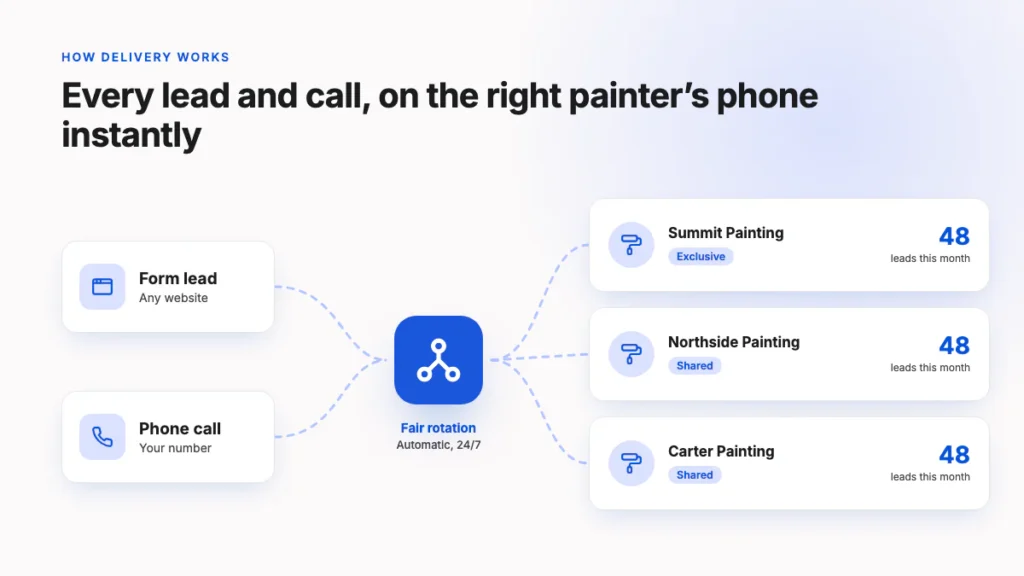
Fix delivery and you fix most of your churn. Here’s what that looks like.
Without a system: you’re the system. Every lead waits for you to see it, copy it, and decide whose turn it is. It works while you’re awake and holding your phone. Then spring hits, leads start landing at 9pm on a Saturday, and you’re forwarding them from a restaurant table.
With a system:
- The lead lands on the buyer’s phone instantly, as a notification. The painter sees the name, number, and job, and one tap starts the call while the homeowner is still on your page. They don’t have to go looking. The lead finds them.
- Leads rotate evenly through all your buyers. Everyone gets their fair share, exclusive and shared buyers alike, and if anyone falls behind, the system catches them up. Nobody argues about whose turn it was, because nobody’s deciding. (Here’s how fair rotation works.)
- The right lead goes to the right buyer. Route by ZIP code, or by job type (interior vs. exterior), so each buyer only gets the work they want, in the area they cover.
- Every call becomes a lead. Publish one number on your site, ads, or Google Business Profile. Each call rings one buyer, in turn. If they answer, it’s logged as a phone-call lead with the talk time. If they can’t pick up, it’s a missed-call lead with the caller’s number and a call-back button, and it stays that buyer’s lead. Nothing is lost.
- It runs whether you’re there or not. Set the rules once. Nights, weekends, and the busiest week of the year all run the same way.
Buyers who get leads this fast close more. Buyers who close more stop shopping around, stop haggling, and quietly start buying more.
How to run all of it with Easy Lead Distribution
Easy Lead Distribution is a lead capture and distribution app built for exactly this business: selling painting leads to painters.
Capture on any website. On WordPress, use the ELD Forms plugin. On any other site, add one small snippet once and build the form right in the ELD app. Either way you get a form builder made for lead gen: multi-step forms, popups, sticky bars, and full-page forms on your own domain for paid traffic. UTM tracking and Google Ads and Meta Pixel conversion tracking are built in. That’s one tool where most sellers pay for four, plus Zapier.
Calls included. Every plan includes dedicated phone numbers and call minutes. You get your number in seconds, publish it anywhere, and every call rings your buyers in turn. No separate call tracking product, and no extra bill.
Exclusive, shared, or both, from the same site. Pick for each buyer. Before you sign anyone, the Lead Selling Simulator shows how many leads each buyer will get per month, so you can price your offer with real numbers.
Nothing for your buyers to learn. They download the app, log in, and leads start arriving on their phone. No dashboard, no CRM, no training call. Lead buyers access the app for free, and you can add as many as you want on every plan.
Live in minutes. Connect your site, add your buyers, and you’re distributing. No developer, no setup calls.
Plans start at $99 a month, and every plan includes every feature. See plans and pricing.
Your only job is growing the business: more painting leads, more painters, more cities. Distribution is ours.
Frequently asked questions
How much can you sell painting leads for?
It depends on exclusivity, job value, and how competitive your market is, so treat any universal price list with suspicion. The quickest way to find your number is to ask a few painters what they pay per lead today and how many they close. Then price so their cost per closed job comes out lower with you. Exclusive leads and live calls earn the top of the range. Shared leads sell for less each, but to more buyers.
Should I sell exclusive or shared painting leads?
Most sellers end up doing both. Exclusive leads earn more per lead and suit established buyers who want a territory of their own. Shared leads let smaller painters afford your leads, and each lead earns more in total. Running both from the same site lets you serve every budget.
Are phone calls or form leads worth more?
Calls usually earn more. A caller is a homeowner ready to talk right now, and a call always goes to a single buyer. The catch is that a call is only worth something if somebody answers it, so make sure missed calls are kept as call-back leads instead of going to voicemail and disappearing.
How do I send leads to painters automatically?
Connect your forms and phone numbers to a lead distribution app that delivers each lead straight to the buyer’s phone and rotates leads fairly between your buyers. With Easy Lead Distribution, you connect your site with the WordPress plugin or one small snippet, add your buyers, and every lead and call reaches the right painter instantly.
Do my buyers need a CRM to receive leads?
No, and asking them to use one is a common reason buyers quit. Your painters work from their trucks and job sites, not from a desk. Leads should arrive as a notification on their phone with one tap to call back, with nothing to log into and nothing to learn.
Ready to put your lead generation and distribution on autopilot?
Run your lead business from one app.
Get Started